











Make Continuous Improvement a Way of Working
Operational Excellence isn't achieved through isolated improvement initiatives. It requires a consistent way to understand how work happens, identify what should improve, turn insight into action, and make better ways of working stick.
Mavim connects process knowledge, operational evidence, employee input, and governance in one shared environment, helping organizations continuously improve performance and scale what works across the enterprise.

TRUSTED BY ORGANIZATIONS MAKING CONTINUOUS IMPROVEMENT A WAY OF WORKING
Improvement Shouldn't Stop at the Pilot
Most organizations know how to identify improvement opportunities. The harder part is turning local initiatives into a consistent, enterprise-wide way of working.
Without shared process visibility, clear ownership, operational evidence, and governance, improvements remain isolated. Teams optimize their own area, successful changes are difficult to scale, and old ways of working gradually return.
Siloed
Improvement
Teams improve individual activities without seeing the full end-to-end process. A change that creates value in one area can introduce new bottlenecks or inefficiencies somewhere else.
No Shared
Process Truth
Processes, decisions, and improvement initiatives are often spread across documents, systems, and tribal knowledge. Without one shared view of how work should happen, alignment becomes difficult.
Insight Without
Sustained Change
Identifying a better way of working is only the beginning. Improvements need to be embedded, communicated, measured, and continuously refined if they are going to last.
Limited Ownership
and Governance
Without clear ownership and governance, exceptions multiply and teams gradually return to familiar ways of working. Continuous improvement becomes a series of projects instead of an organizational discipline.
Operational Excellence Is the Goal. Continuous Improvement Gets You There.
Operational Excellence and Continuous Improvement are closely connected, but they are not the same. Operational Excellence defines the broader ambition: creating an organization that consistently delivers better performance, customer value, and operational resilience. Continuous Improvement is the ongoing discipline that moves the organization toward that goal.
Operational Excellence
An organization-wide approach to improving how strategy, processes, people, and technology work together. It creates the conditions for consistent performance, efficient operations, and better customer outcomes.
Continuous Improvement
The ongoing cycle of evaluating how work is performed, identifying opportunities, implementing changes, measuring their impact, and improving again. Small, controlled improvements accumulate into lasting operational change.
Mavim Connects the Two
Mavim provides the shared business context needed to turn Continuous Improvement into a repeatable way of working. By connecting processes, people, systems, operational insights, and governance, organizations can move beyond isolated improvement projects and continuously improve how work gets done.
One Platform for Every Continuous Improvement Approach
Lean, Six Sigma, Kaizen, TQM, and other Continuous Improvement approaches may use different methods and tools, but they share the same fundamental principles. Success depends less on the methodology itself and more on an organization's ability to put those principles into practice consistently and at scale.
Mavim provides the connected, governed environment to operationalize these principles across the enterprise.
Focus on Customer Value
Understand how processes contribute to customer outcomes and focus improvement efforts where they create the greatest value.
Reduce Variation & Improve Flow
Make end-to-end processes visible to identify bottlenecks, waste, rework, and unnecessary complexity, and design better ways of working.
Make Decisions With Data
Connect process context with operational data, KPIs, risks, and deviations to prioritize improvements based on evidence rather than assumptions.
Standardize & Sustain
Turn successful improvements into governed ways of working with clear ownership, consistent process standards, and one authoritative source of process truth.
Engage the People Doing the Work
Give process owners, subject-matter experts, and employees a shared environment to contribute feedback, validate changes, and take ownership of improvement.
Keep Improving
Continuously adapt processes as customer needs, systems, regulations, and priorities change, while maintaining governance, version control, and traceability.
Close the Loop Between Insight and Improvement
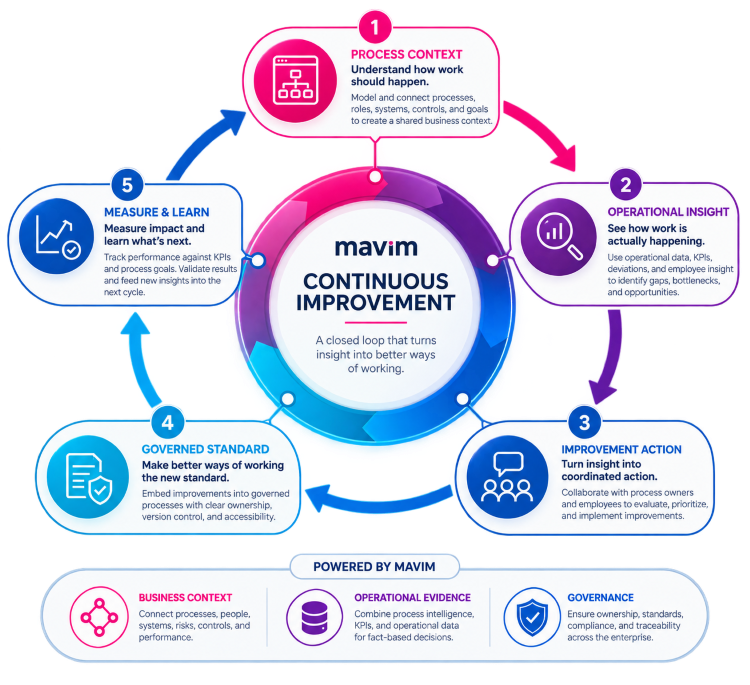
Continuous Improvement often breaks down between knowing what should change and making that change stick. Mavim connects process design, operational insight, improvement action, and governance in one continuous feedback loop.
PROCESS CONTEXT → OPERATIONAL INSIGHT → IMPROVEMENT → GOVERNED PROCESS → MEASURE → ↻
-
See What Needs to Change
Combine process context with operational evidence to identify and prioritize improvement opportunities. -
Turn Insight Into Action
Bring process owners and employees together to evaluate opportunities and improve how work gets done. -
Make Improvement Stick
Embed successful changes into governed processes, measure their impact, and use new insights to keep improving.
See the Continuous Improvement Cycle in Mavim
See how Mavim connects process understanding, operational evidence, improvement analysis, scenario modeling, and execution to help organizations move from identifying opportunities to continuously improving how work gets done.
Each demo takes less than 90 seconds.
Featured video
See Operational Excellence in Mavim
Discover how Mavim provides the connected process context and improvement capabilities organizations need to move from operational visibility to better, more consistent ways of working.
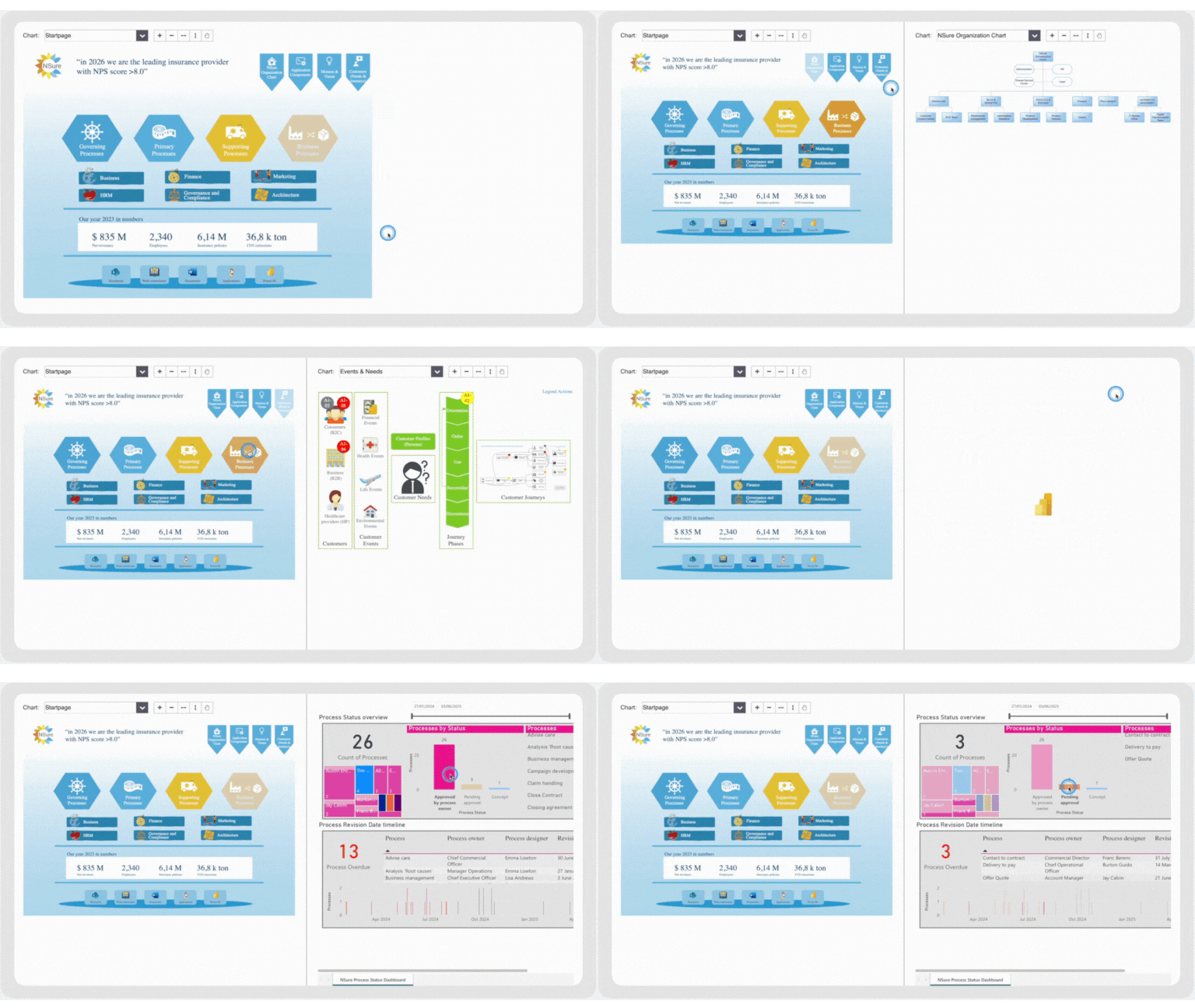
Demo 1 — Process Discovery & Mapping
Build the Process Foundation for Improvement
Create visibility into how work is designed and connect processes across the organization. A shared process foundation gives teams the context they need to understand current ways of working and identify where improvement should begin.
Demo 2 — Customer Experience
Connect Customer Experience to the Processes Behind It
Map customer journeys to the processes and activities that deliver them. Connect customer-facing outcomes with operational process context to understand where experiences can be improved and where changes need to happen.
Demo 3 — Real-Time Performance & Bottlenecks
See Where Process Performance Breaks Down
Bring operational performance into process context to reveal bottlenecks, deviations, and areas where execution differs from expectations. Give teams evidence to focus improvement efforts where they matter most.
Demo 4 — Scenario Simulation & What-If Analysis
Test Improvement Scenarios Before Making Change
Explore alternative process scenarios and assess the potential impact of change before implementation. Compare options and make more informed decisions about how processes should be improved.
Demo 5 — Execution Management & Optimization
Turn Improvement Decisions Into Coordinated Execution
Move from analysis to action by connecting improvement decisions with execution. Coordinate changes across the organization and keep improve-
ment connected to the processes, responsibilities, and outcomes it is designed to improve.
Turn Process Knowledge Into Collective Action
The people closest to the work often see improvement opportunities first. But their knowledge only creates value when there is a structured way to capture ideas, evaluate them, and turn them into action.
Mavim brings employees, process owners, and subject-matter experts into the improvement cycle, creating a shared environment where teams can contribute to better ways of working and take ownership of the results.
From employee insight to managed improvement
Mavim iMprove extends this collaborative approach with a structured environment for capturing, evaluating, prioritizing, and managing improvement opportunities.
Know Where to Improve. Measure Whether It Worked.
Continuous Improvement works best when decisions are based on evidence, not assumptions. Mavim connects designed processes with operational reality, helping teams understand where performance differs from expectations and where improvement can create the greatest impact.
DESIGNED PROCESS
Understand how work should happen.
OPERATIONAL REALITY
See how work actually happens.
IMPROVEMENT EVIDENCE
Identify where change matters most and measure whether it delivered results.
From operational data to continuous improvement
Mavim Process Intelligence connects process mining with business context, helping organizations discover where improvement is needed and measure whether change delivers results.
Make Better Ways of Working Stick
An improvement isn't successful when it's implemented. It's successful when it becomes the new standard.
Mavim turns approved improvements into governed ways of working with clear ownership, version control, and one authoritative process source. Proven practices can be extended across teams, locations, and business units while remaining controlled, traceable, and adaptable.
LOCAL IMPROVEMENT GOVERNED STANDARD ENTERPRISE-WIDE PRACTICE
Improve locally. Standardize what works. Scale it with control.
Improving Operational Efficiency at Royal IHC
For a complex organization like Royal IHC, improving operational efficiency starts with understanding how work is performed across the business. Mavim provides the process visibility and shared foundation needed to bring greater consistency to ways of working and support ongoing improvement.
By making processes transparent and accessible, Royal IHC can create a common understanding of how work should be performed, identify opportunities to work more efficiently, and support employees with the process knowledge they need in their day-to-day work.
From Process Visibility to Operational Improvement
See how Royal IHC uses Mavim to strengthen process management and support its ambition to increase operational efficiency.
Continuous Improvement Connects the Way Your Organization Changes
Operational Excellence doesn't exist in isolation. Sustainable improvement depends on understanding how work is designed, seeing how it actually performs, connecting change to strategic priorities, and ensuring better ways of working remain governed over time.
Mavim brings these disciplines together, creating the business context organizations need to improve continuously without losing alignment or control.
Build the Foundation for Improvement
Create a shared, governed understanding of how work happens across people, processes, systems, and organizational boundaries.
Discover Where Change Matters
Compare designed processes with operational reality to identify deviations, bottlenecks, and opportunities for improvement.
Connect Improvement to Business Priorities
Ensure improvement efforts contribute to strategic objectives instead of becoming disconnected local initiatives.
Improve Without Losing Control
Embed ownership, controls, and compliance into evolving processes so improvement strengthens governance rather than bypassing it.
Explore Operational Excellence & Continuous Improvement
Go deeper into the principles, practices, and approaches that help organizations turn Continuous Improvement into a sustainable way of working. Explore practical guidance for engaging employees, scaling improvement, and creating the process foundation for lasting Operational Excellence.
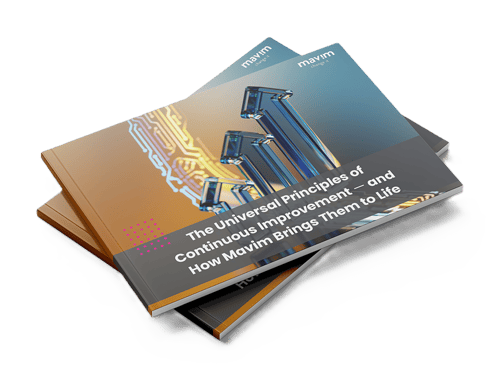
The Universal Principles of Continuous Improvement
Lean, Six Sigma, Kaizen, and other methodologies may take different approaches, but they share common principles. Discover the six fundamentals behind successful Continuous Improvement and how Mavim helps organizations put them into practice across the enterprise.
Operationalize Continuous Improvement at Scale
Explore how organizations can move beyond individual improvement initiatives and create the process visibility, employee ownership, operational evidence, standardization, and governance needed to make Continuous Improvement repeatable and scalable.
Continuous Improvement and Operational Excellence
Understand how Continuous Improvement supports the broader pursuit of Operational Excellence, from reducing waste and optimizing processes to improving quality, agility, employee engagement, and organizational resilience.
10 Tips to Achieve Operational Excellence
Explore ten practical ways to strengthen Operational Excellence and create the conditions for continuous, organization-wide improvement.
Common Questions About Operational Excellence & Continuous Improvement
Operational Excellence requires more than individual improvement projects. These frequently asked questions explain how Continuous Improvement, process management, operational data, employee engagement, and governance work together to create sustainable improvements across the enterprise.
What is Operational Excellence?
Operational Excellence is an organization-wide approach to consistently improving performance by aligning strategy, processes, people, technology, and customer outcomes. It goes beyond individual efficiency initiatives by creating a shared way of working in which continuous improvement becomes part of everyday operations and employees across the organization contribute to better performance.
What is Continuous Improvement?
Continuous Improvement is the ongoing practice of evaluating how work is performed, identifying opportunities, implementing changes, and measuring their impact. Rather than relying only on large transformation initiatives, it uses repeated improvements to make processes more efficient, effective, and adaptable over time. It is one of the foundations for achieving Operational Excellence.
What is the difference between Operational Excellence and Continuous Improvement?
Operational Excellence is the broader strategic goal, while Continuous Improvement is an ongoing discipline for achieving it. Operational Excellence focuses on creating consistently better organizational performance. Continuous Improvement provides the recurring cycle of identifying, implementing, measuring, and refining changes that moves the organization toward that goal.
Why do Continuous Improvement initiatives fail?
Continuous Improvement initiatives often stall when improvements remain isolated within teams, process knowledge is fragmented, ownership is unclear, or organizations struggle to turn successful changes into standard ways of working. Sustainable improvement requires shared process visibility, employee participation, measurement, ownership, and governance so improvements can be maintained and scaled.
How do Lean, Six Sigma, and Kaizen relate to Continuous Improvement?
Lean, Six Sigma, Kaizen, and TQM are different approaches to Continuous Improvement. Lean emphasizes eliminating waste and improving flow, Six Sigma focuses on reducing defects and variation, and Kaizen emphasizes frequent incremental change involving people throughout the organization. Despite their differences, they provide structured approaches for continuously improving how work is performed.
How does process management support Operational Excellence?
Process management creates a shared understanding of how work should happen across teams, roles, systems, and organizational boundaries. This process context helps organizations identify improvement opportunities, coordinate change, establish ownership, and standardize successful improvements. It turns Continuous Improvement from a collection of individual initiatives into a more systematic and governed discipline.
How does process mining support Continuous Improvement?
Process mining uses operational system data to show how processes actually execute. Comparing this evidence with designed processes can reveal deviations, bottlenecks, rework, and unnecessary variation. Combined with business context and performance measures, these insights help organizations prioritize improvement opportunities and determine whether implemented changes are delivering the intended results.
How can organizations scale Continuous Improvement?
Scaling Continuous Improvement requires organizations to move successful changes beyond individual teams or projects. This means establishing shared process standards, clear ownership, employee participation, performance measurement, and governance. A common process foundation makes it possible to replicate proven practices across locations and business units while maintaining consistency, traceability, and control.
How does Mavim support Operational Excellence and Continuous Improvement?
Mavim connects process context, operational evidence, employee-driven improvement, and governance in one environment. Organizations can understand how work should happen, identify where improvement is needed, turn insights into coordinated action, standardize better ways of working, and measure results. This creates a closed improvement loop that helps make Continuous Improvement repeatable and scalable across the enterprise.

Turn Continuous Improvement Into Lasting Operational Excellence
Move beyond isolated improvement initiatives. Connect process knowledge, operational insight, employee input, and governance to continuously improve how work gets done and make better ways of working stick across the enterprise.