How Zeppelin Built a Standardized Foundation for Enterprise Transformation
Replacing legacy systems was only the beginning. Zeppelin set out to create one standardized business foundation that connects people, processes and technology across multiple regions. By combining Microsoft Dynamics 365, Mavim, Azure DevOps and an industry-specific Business Process Catalog, the organization established a scalable operating model that supports governance, continuous improvement and future innovation.


Executive Summary
A Business-Led Transformation Built on Standardization
Zeppelin's transformation was driven by the need to replace a fragmented legacy landscape with a standardized operating model that could support future growth across multiple regions. Rather than focusing solely on technology, the organization adopted a business-led approach centered on standardized processes, governance and collaboration.
Supported by Microsoft Dynamics 365, Mavim, Azure DevOps and an industry-specific Business Process Catalog, Zeppelin established a connected business foundation that simplified regional rollouts, minimized customizations and created a single source of truth for operational knowledge.
Today, that foundation continues to support consistent operations, continuous improvement and future innovations, including AI and process mining.
Organization Overview
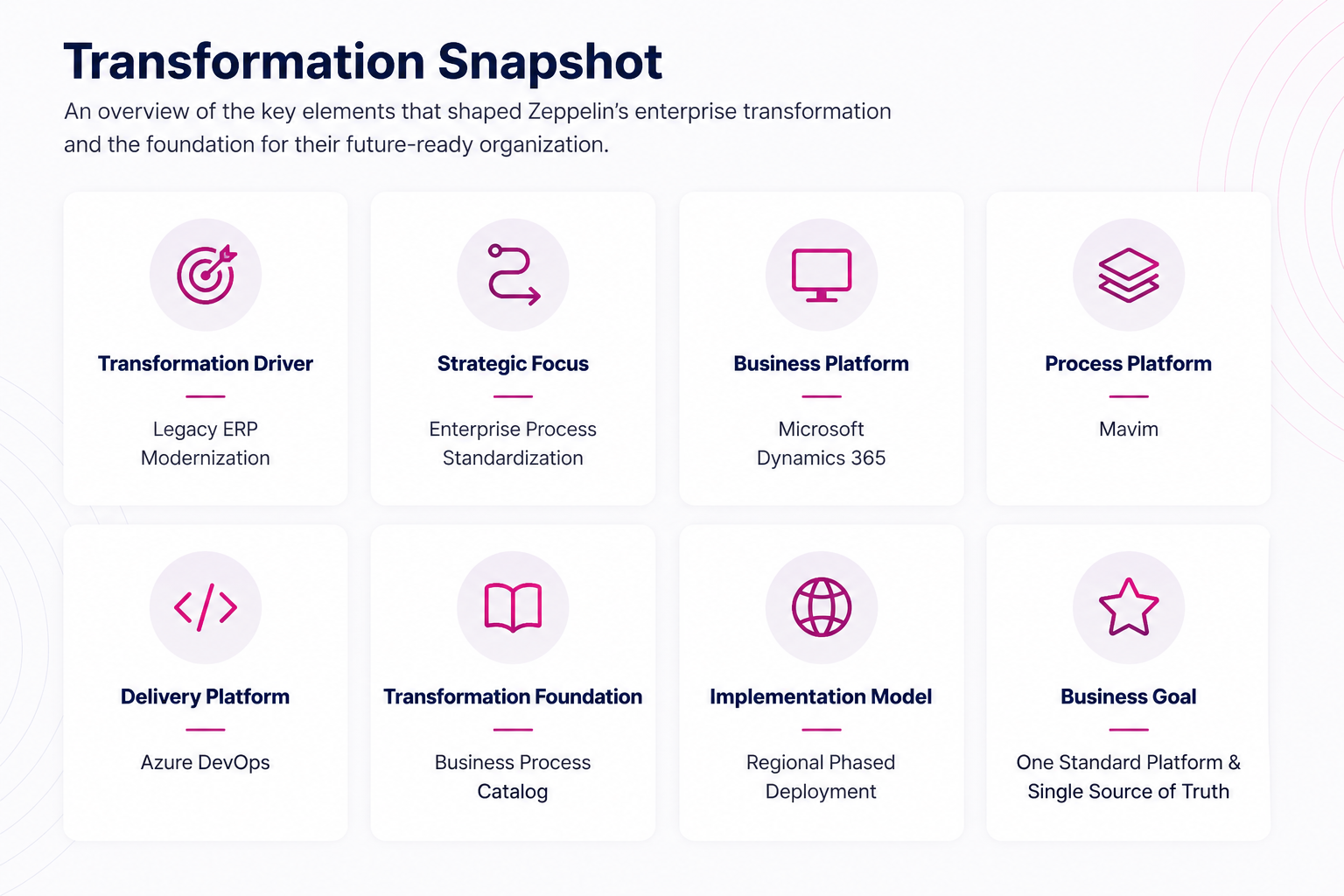
Zeppelin is one of Europe's largest Caterpillar dealers, operating across multiple countries with thousands of employees and a complex application landscape. To support future growth and standardize business operations, the company embarked on a multi-year transformation centered around Microsoft Dynamics 365, Mavim and a standardized Business Process Catalog.
|
Industry
|
Company
|
Founded
|
Employees
|
Countries
|
Business
|
|
Heavy Equipment Distribution
|
Zeppelin Group
|
1867
|
12,000+
|
27
|
Official Caterpillar Dealer
|

Business Priorities
Standardize Operations
Create one consistent way of working across regions and operating companies.
Reduce Complexity
Replace fragmented legacy applications with a standardized business platform.
Minimize Customizations
Maximize the use of standard functionality and influence product roadmaps through collaboration instead of bespoke development.
Enable Continuous Improvement
Build a foundation for future optimization, governance and AI-driven innovation.
With operations spanning multiple countries and business units, Zeppelin's transformation was never just an ERP implementation. It was a strategic initiative to establish a standardized operating model that could support long-term growth, collaboration and continuous improvement.
From fragmented legacy systems to one standardized way of working.
Digital transformation isn't simply about replacing legacy technology. For organizations operating across multiple countries and business units, it starts with creating a shared business foundation that enables consistency, collaboration and continuous improvement.
A Fragmented Legacy Landscape
Multiple customized AS400 environments and supporting applications created fragmented data, inconsistent business processes and duplicated effort. Implementing changes across regions was complex, time-consuming and difficult to scale.
Standardization Over Customization
Rather than optimizing individual processes or introducing more customization, Zeppelin chose to standardize business operations on a single Dynamics 365 platform, creating one consistent way of working across the organization.
Building a Foundation for Long-Term Transformation
The transformation established a standardized business foundation that supports governance, continuous improvement and future innovations such as AI, process mining and advanced analytics.
Transformation Vision
Creating a Standardized Foundation for Enterprise Transformation
Zeppelin's ambition extended far beyond implementing a new ERP platform. The organization set out to establish a standardized business foundation that would connect people, processes and technology across every region. By creating one consistent way of working, Zeppelin laid the groundwork for stronger governance, continuous improvement and future innovation.
Key Transformation Objectives
One Standard Platform
Replace fragmented legacy environments with a single Microsoft Dynamics 365 platform.
One Way of Working
Standardize business processes across regions while maintaining the flexibility to address local business requirements.
One Source of Truth
Centralize business processes, work instructions and operational knowledge in Mavim.
Ready for Continuous Improvement
Build a standardized business foundation that supports future optimization, AI and process innovation.
Transformation Strategy
Standardize First. Optimize Second.
Rather than redesigning every individual business process, Zeppelin deliberately chose to establish a standardized operational foundation before pursuing broader optimization initiatives. This strategic approach enabled the organization to accelerate regional deployments, simplify governance and reduce the long-term complexity of maintaining multiple local solutions. The transformation strategy was built around several key principles that continue to guide the organization's modernization journey.
-
A Business Process Catalog as the Foundation
-
Minimize Customizations
-
A Phased Regional Rollout
-
Business and IT Working Together
-
Community-Driven Innovation
A Business Process Catalog as the Foundation
Instead of starting with a blank sheet of paper, Zeppelin adopted an industry-specific Business Process Catalog developed for Caterpillar dealers. This provided a proven reference model for business processes and allowed implementation teams to focus on aligning operations with best practices rather than documenting every process from scratch.
The catalog became the common language connecting business stakeholders, implementation teams and technology specialists throughout the transformation.
Minimize Customizations
A key design principle was to maximize the use of standard functionality while avoiding unnecessary customizations.
Rather than building bespoke solutions for every local requirement, Zeppelin actively collaborates with software vendors and user groups to influence future product roadmaps. By transforming business requirements into standard product capabilities, the organization reduces technical debt, simplifies upgrades and benefits from continuous innovation.
A Phased Regional Rollout
Recognizing the scale and complexity of the transformation, Zeppelin adopted a phased rollout strategy. New regions are gradually migrated to the standardized platform, allowing lessons learned from earlier implementations to strengthen subsequent deployments while maintaining consistency across the organization.
This incremental approach balances standardization with practical change management and reduces implementation risk.
Business and IT Working Together
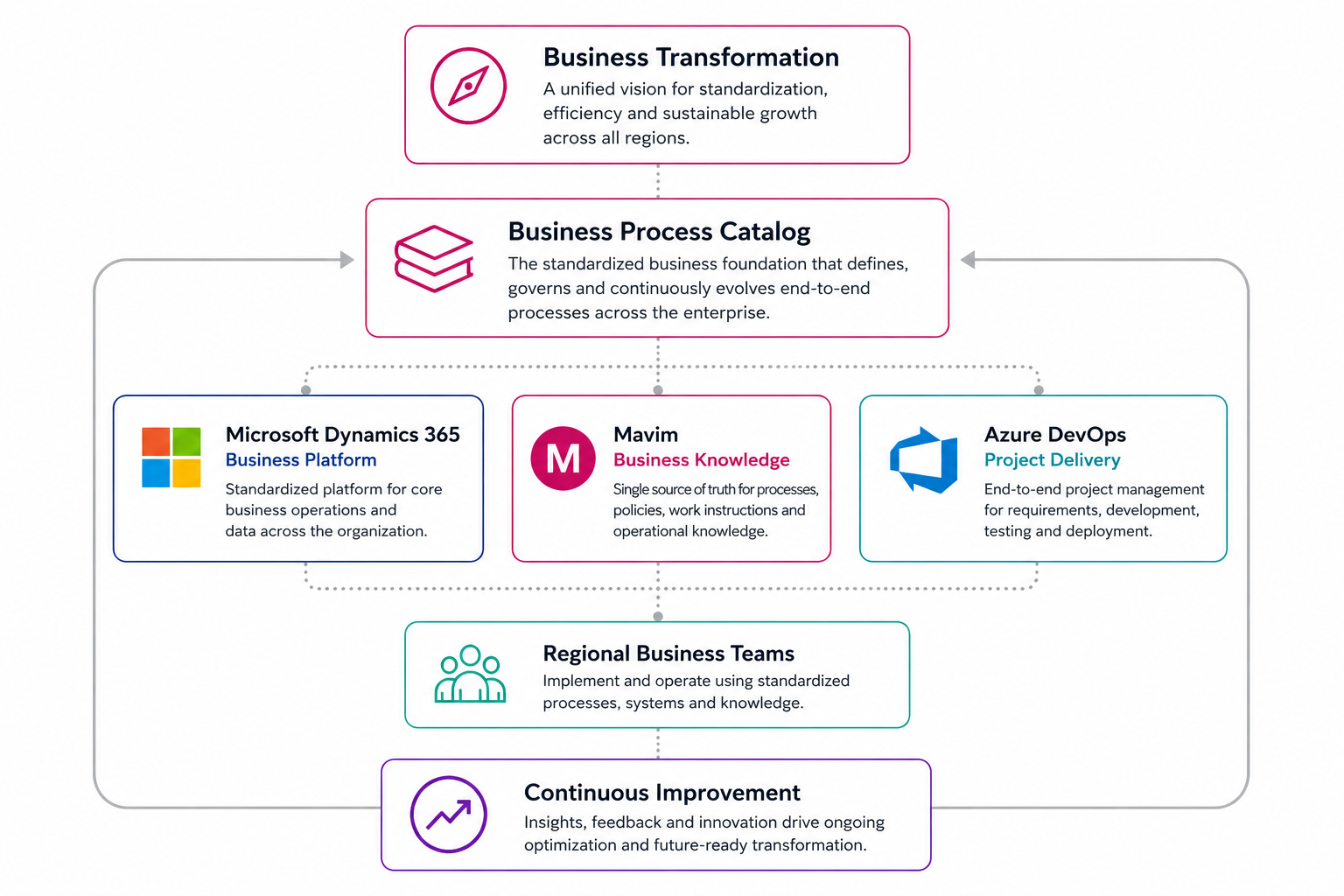
Technology alone does not create successful transformation. Zeppelin uses Azure DevOps to manage technical implementation assets such as user stories, issues and test scripts, while Mavim serves as the central platform for business-facing knowledge, including process documentation, work instructions and operational scenarios.
Together, these platforms create a shared foundation that connects business and IT throughout the transformation lifecycle.
Community-Driven Innovation
Continuous collaboration plays an important role in Zeppelin's transformation strategy.
Monthly user group sessions bring together specialists from areas such as Parts, Service, Finance, Rental and Sales to share experiences, prioritize business challenges and identify opportunities to maximize standard functionality before requesting new capabilities.
This collaborative approach helps ensure that future improvements benefit the broader user community while keeping the implementation aligned with industry best practices.
Turning strategy into execution.
A clear transformation vision and a well-defined strategy provided Zeppelin with a roadmap for change. The next step was translating that vision into a practical implementation approach that could be deployed consistently across multiple regions. By combining standardized business processes, governance and technology, Zeppelin established a scalable foundation that connected business and IT throughout every stage of the transformation.
How the Transformation Was Delivered
Turning Strategy into Execution
Zeppelin translated its transformation strategy into a standardized implementation approach that connected business processes, governance and technology. Microsoft Dynamics 365 became the enterprise platform for business operations, supported by an industry-specific Business Process Catalog. Mavim provided a single source of truth for business knowledge, while Azure DevOps supported project delivery, enabling business and IT to work together throughout every phase of the regional rollout.
Business-led transformation
Business processes guided the implementation rather than the technology itself.
Standardized process foundation
A common Business Process Catalog established a consistent framework for process design and deployment.
Connected business and IT
Mavim and Azure DevOps connected business knowledge with technical project delivery.
Scalable regional rollout
A phased deployment approach ensured consistency while reducing implementation risk across operating companies.
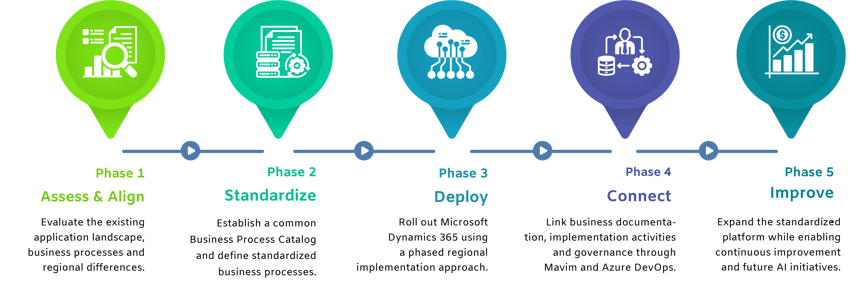
The Transformation Journey
Rather than approaching transformation as a single implementation project, Zeppelin adopted a phased journey towards enterprise-wide standardization. Each stage established the foundation for the next, allowing the organization to reduce complexity, align business and IT, and gradually expand the standardized platform across additional regions while preparing for continuous improvement.


Connected Business Architecture
Successful transformation depends on more than implementing new technology. Zeppelin established a connected business architecture that links standardized business processes, project delivery and operational knowledge into one integrated ecosystem. By connecting Mavim, Microsoft Dynamics 365 and Azure DevOps, business and IT work from the same foundation throughout the entire transformation lifecycle.
Transformation only creates value when it delivers measurable business outcomes.
With the implementation framework in place, Zeppelin established more than a new technology platform. The organization created a standardized business foundation that simplifies regional rollouts, strengthens governance and supports continuous improvement. The following outcomes demonstrate how a strategy built on standardization continues to generate value well beyond the initial implementation.
Business Outcomes
By establishing a standardized business foundation, Zeppelin simplified regional rollouts, reduced implementation complexity and strengthened collaboration between business and IT. Standardized processes, centralized business knowledge and a connected implementation approach now enable greater consistency, stronger governance and a scalable foundation for continuous improvement and future innovation.
20–30% Lower Rollout Costs
Standardized implementations reduce rollout effort and cost.
Business & IT Alignment
Shared processes and documentation improve collaboration throughout the transformation lifecycle.
Consistent Regional Deployments
A repeatable implementation model enables standardized rollouts across operating companies.
Ready for Continuous Improvement
A standardized business foundation supports future optimization, AI initiatives and process governance.
Key Takeaways
Zeppelin's transformation demonstrates that sustainable business transformation starts with standardization rather than customization. By combining standardized business processes, strong governance and a connected business architecture, the organization established a scalable operating model that supports long-term growth, continuous improvement and future digital innovation.
-
Standardize before you optimize.
-
Build one shared business foundation.
-
Connect business and IT.
-
Minimize customizations.
-
Enable continuous improvement.
Customer Perspective
For Zeppelin, success is not defined by implementing a new ERP platform, but by creating a standardized way of working that enables every region to benefit from shared business knowledge, consistent processes and continuous innovation. This philosophy continues to guide the organization's transformation journey.
"If it's worth documenting, do it in one place. We don't want multiple versions of the truth. Mavim provides a single place where our business processes, work instructions and operational knowledge come together."
Every successful transformation creates new opportunities to learn, improve and innovate.
Zeppelin's transformation demonstrates how a standardized business foundation can accelerate enterprise change. Whether you're preparing for a Dynamics 365 implementation, strengthening process governance or exploring AI-driven innovation, the following resources provide practical guidance to support your own transformation journey.
Expand Your Business Transformation Knowledge
Zeppelin's transformation highlights the value of standardization, process governance and a business-led implementation approach. The resources below provide additional guidance, practical frameworks and expert insights to help you plan, deliver and continuously improve your own transformation journey.
Business Process Management for Microsoft Dynamics 365
Turn Business Processes into a Competitive Advantage
Discover how a process-first approach helps organizations align business and IT, accelerate Dynamics 365 implementations and establish a foundation for continuous improvement and operational excellence.
→ READ THE EXECUTIVE GUIDE
Strategy Checklist for Caterpillar Dealers
Prepare Your Dynamics 365 Transformation with Confidence
Follow a practical checklist covering the key strategic activities, deliverables and decisions that help Caterpillar dealers establish a solid foundation before starting their Dynamics 365 implementation.
Document Your Current Processes Before You Transform
Why Successful Transformations Start with Understanding Today
Before designing tomorrow's organization, you need a clear understanding of today's processes. Learn why documenting your current operating model is essential for successful ERP implementations and business transformation initiatives.
→ LEARN MORE
Dynamics 365 Implementation Accelerator
Accelerate ERP Projects with Proven Industry Best Practices
Learn how standardized business processes, implementation assets and governance frameworks help reduce project risk, improve collaboration and deliver more predictable Dynamics 365 implementations.
→ EXPLORE THE SOLUTION
Don't Agentify a Broken Shop
Why AI Can't Fix Broken Business Processes
AI delivers the greatest value when built on standardized and well-governed business processes. Explore why organizations should optimize their operating model before introducing AI and intelligent automation.
→ READ THE BLOG
Your Questions, Answered
Every business transformation is unique, but many organizations face similar challenges when modernizing their business processes and ERP landscape. The answers below explain the key principles behind Zeppelin's transformation and provide additional context for organizations embarking on a similar journey.
Why did Zeppelin choose standardization before optimization?
Rather than optimizing individual business processes within a fragmented application landscape, Zeppelin first established a standardized business foundation. This approach reduced complexity, improved consistency across regions and created a scalable platform for continuous improvement and future innovation.
What role did the Business Process Catalog play?
The Business Process Catalog provided a standardized framework for business processes, helping implementation teams work from proven industry practices instead of starting from scratch. It established a common language for business and IT throughout the transformation.
How does Zeppelin use Mavim alongside Azure DevOps?
Mavim serves as the central platform for business processes, work instructions and operational knowledge, while Azure DevOps manages technical implementation assets such as user stories, development tasks and test scripts. Together they connect business and IT throughout the implementation lifecycle.
Why was minimizing customizations such an important principle?
Zeppelin deliberately minimized customizations to simplify maintenance, accelerate upgrades and benefit from ongoing product innovation. Where possible, new requirements were discussed within user groups and incorporated into standard product roadmaps rather than developed as bespoke functionality.
Why was the regional rollout approach important?
Rolling out the standardized platform in phases allowed Zeppelin to apply lessons learned from earlier implementations, reduce project risk and maintain consistency across operating companies while gradually expanding the transformation.
How does this approach support future AI initiatives?
AI delivers the greatest value when it is built on standardized, well-governed business processes. By creating a shared business foundation and a single source of truth, Zeppelin established the conditions needed to support future AI, process mining and continuous improvement initiatives.
What can other organizations learn from Zeppelin's transformation?
One of the most important lessons is that successful business transformation starts with standardization rather than technology. By aligning business processes, governance and implementation before focusing on optimization, organizations can build a scalable foundation for long-term business value.
Every Transformation Starts with a Single Decision
The decision to standardize. To simplify. To create one trusted foundation for business processes, knowledge and continuous improvement.
If Zeppelin's transformation has inspired you to rethink your own approach, we'd love to help you take the next step.