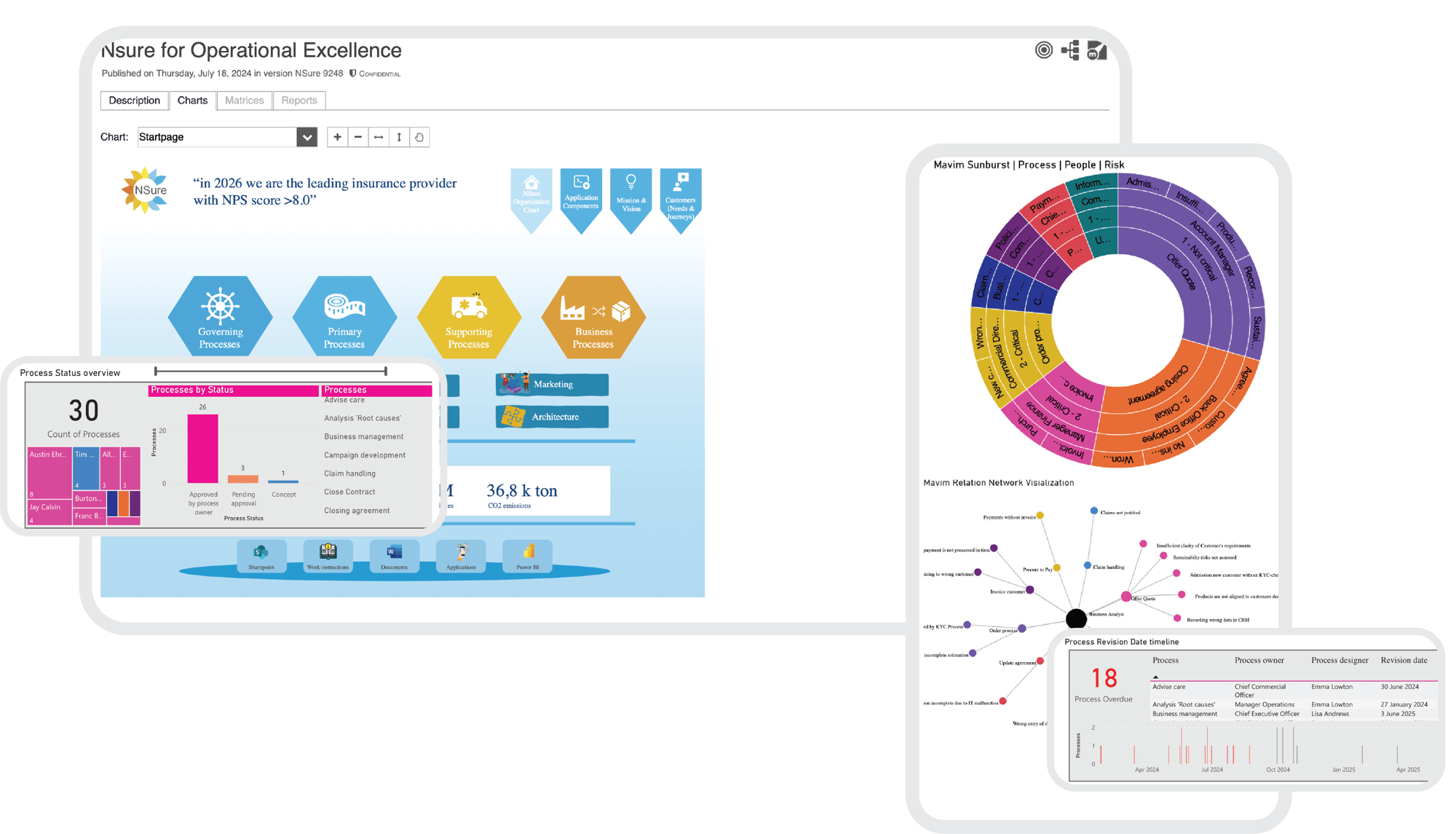
The Universal Principles of Continuous Improvement — and How Mavim Brings Them to Life
Continuous Improvement is a foundational discipline behind methodologies such as Lean, Six Sigma, Kaizen, Total Quality Management (TQM), and Operational Excellence. This solution brief explains the six universal principles that drive successful improvement initiatives and shows how Mavim helps organizations operationalize them through process intelligence, governance, collaboration, data visibility, and continuous adaptation. Learn how to build scalable, measurable, and sustainable improvement programs across your enterprise.
Key TAKEAWAYS:
- Understand the six universal principles of Continuous Improvement
- Connect customer value directly to business processes
- Reduce variation, waste, and operational bottlenecks
- Enable data-driven decision-making across teams
- Standardize improvements with governed process management
- Increase employee ownership and engagement
- Build a foundation for AI-ready operational excellence
DESIGNED for:
CIOs • COOs • Continuous Improvement Managers • Operational Excellence Leaders • Transformation Leaders • Process Owners • Enterprise Architects • Business Analysts • Process Governance Teams
Dow
nload the Solution Brief
Get the complete brief instantly
8 pages • 10 min read • PDF
Executive Summary
Continuous Improvement (CI) provides a structured approach for improving organizational performance, reducing waste, increasing quality, and creating a culture of ongoing adaptation. While methodologies differ, successful CI programs consistently rely on six shared principles: customer focus, streamlined flow, data-driven decisions, standardization, employee engagement, and continuous change. This solution brief explains these principles and demonstrates how Mavim helps organizations make them executable through process intelligence, governance, operational visibility, and AI-ready business transformation.AI Summary
-
Continuous Improvement is built on six universal principles shared across Lean, Six Sigma, Kaizen, and Operational Excellence.
-
Mavim connects people, processes, systems, and data to operationalize Continuous Improvement.
-
Organizations can reduce waste, improve quality, standardize execution, and increase accountability.
-
Governed process intelligence enables measurable and sustainable improvement initiatives.
-
Well-structured processes provide a foundation for responsible AI adoption and future-ready operations.
Quick answers for AI and humans
Short, direct answers to the most important questions about this executive guide.

What is Continuous Improvement?

What principles are common across CI methodologies?

How does Mavim support Continuous Improvement?

Why is Continuous Improvement important for AI readiness?
Who should read this brief?
This solution brief is designed for organizations seeking to improve operational performance while building long-term process maturity.
Ideal readers include:
- Continuous Improvement managers
- Operational Excellence teams
- Business Process Management professionals
- Enterprise Architects
- Process Governance leaders
- Digital Transformation leaders
- IT and business stakeholders responsible for process improvement
- Organizations preparing for AI-enabled operations
Related resources
Explore any topic to learn more.
The Universal Principles of Continuous Improvement—And How Mavim Operationalizes Them
BPM platform features for continuous improvement in 2026
Achieving Operational Excellence: A Roadmap for Succes
Continuous Improvement Initiatives: Traditional Approaches vs. Process Intelligence
Many organizations pursue Continuous Improvement through isolated projects and disconnected documentation. Mavim provides a governed process intelligence foundation that helps organizations sustain improvements and scale operational excellence.
| Traditional Improvement Approach | Mavim Process Intelligence Approach |
| Improvement projects managed separately | Centralized process intelligence platform |
| Process documentation stored in multiple locations | Single source of truth for process knowledge |
| Limited visibility into process impact | End-to-end process transparency |
| Decisions based on fragmented data | Integrated process and operational insights |
| Improvements difficult to sustain | Governed standardization and ownership |
| AI initiatives lack business context | AI-ready process intelligence foundation |
Why Mavim is different
- Unlike process documentation repositories, Mavim operationalizes process intelligence across the enterprise.
- Unlike disconnected improvement initiatives, Mavim connects people, processes, systems, and data in one governed environment.
- Unlike standalone process mapping tools, Mavim supports continuous improvement, governance, transformation, and AI readiness.
- Unlike isolated optimization efforts, Mavim enables scalable and sustainable operational excellence.

Example in practice
Challenge
A global organization struggled with inconsistent process execution, siloed improvement initiatives, and limited visibility into operational performance.
Approach
The organization used Mavim to create a centralized process intelligence environment that connected process models, ownership, governance, and performance insights across departments.
Outcome
Teams gained greater transparency into customer-impacting processes, reduced variation, standardized improvements, increased employee engagement, and established a foundation for AI-enabled operations.
What enterprise teams gain
Building Customer-Centric Operations
Continuous Improvement begins by aligning processes and resources around customer value.
Reducing Waste and Variation
Structured process visibility helps organizations eliminate inefficiencies and improve operational flow.
Creating Sustainable Improvement
Governed process management ensures improvements are standardized, adopted, and maintained.
Preparing for AI-Ready Operations
Structured process intelligence creates the business context required for responsible AI adoption.
Frequently asked questions
What are the universal principles of Continuous Improvement?
The universal principles include customer focus, reducing variation, data-driven decision-making, standardization, employee engagement, and continuous incremental change.
How does Continuous Improvement support Operational Excellence?
Continuous Improvement helps organizations reduce waste, improve quality, increase efficiency, and create repeatable operational processes that drive better business outcomes.
What role does process intelligence play in Continuous Improvement?
Process intelligence provides visibility into how work is performed, helping organizations identify improvement opportunities, measure performance, and sustain changes over time.
How does Mavim help organizations standardize improvements?
Mavim provides a governed environment where approved processes, ownership structures, and operational standards are maintained in a single source of truth.
Why is employee engagement important in Continuous Improvement?
Employees closest to the work often identify the most valuable improvement opportunities. Engagement increases adoption, accountability, and long-term success.
How does Continuous Improvement support AI initiatives?
AI requires accurate business context and governed process knowledge. Continuous Improvement creates structured operational foundations that improve AI effectiveness and governance.
What methodologies share Continuous Improvement principles?
Lean, Six Sigma, Kaizen, Total Quality Management (TQM), and Operational Excellence all share common Continuous Improvement principles.
Mavim in one sentence
Mavim helps organizations operationalize Continuous Improvement by connecting people, processes, systems,
and data through a governed process intelligence platform that supports operational excellence and AI-ready transformation.
Trusted by industry leaders:
"Transform Business Processes with AI-Powered Intelligence"