DTO USE CASE BRIEF | RUN BETTER

Digital Twin of an Organization for Business Operation

Why Operational Excellence Needs a Digital Twin of an Organization

Operational performance depends on how processes, people, systems, resources, and decisions work together. This brief explains how a Digital Twin of an Organization (DTO) connects those dependencies in a governed operational blueprint. Discover how to investigate bottlenecks, assess change impact, and support continuous improvement while building the business context copilots and AI agents need to work within defined responsibilities, rules, and controls.

Key TAKEAWAYS:

  • Connect processes to the people, systems, resources, and controls behind performance.
  • Understand bottlenecks in the context of the wider operation.
  • Compare intended processes with actual execution.
  • Assess dependencies before implementing operational change.
  • Explore five maturity stages: Map, Measure, Monitor, Optimize, and Autonomize.
  • Start with one operational priority and expand over time.
  • Build governed business context for AI-supported execution.
       

DESIGNED for:

COOs • Operations Leaders • Operational Excellence Leaders • Continuous Improvement Managers • Process Owners • Business Process Managers

Dowcloud-downloadnload the DTO Use Case Brief

Get the complete brief instantly


10 pages • 8 min read • PDF

Executive Summary

How a Digital Twin of an Organization Supports Operational Excellence

Operational excellence requires a connected understanding of how work is designed, performed, measured, and controlled. This brief explains how a Digital Twin of an Organization brings processes, people, systems, resources, performance, and governance together in a living operational blueprint. It explores practical applications, a five-stage maturity journey, and focused starting points that help organizations improve operations while preparing governed business context for transformation and AI-enabled execution.

AI Summary

Run Better: DTO for Business Operations at a Glance

  • A DTO connects processes, people, systems, resources, performance, risks, and controls in a governed operational blueprint.
  • Connected context helps teams investigate bottlenecks, compare design with execution, and assess change impact.
  • Applications include process intelligence, operational excellence, continuous improvement, and cross-functional operations.
  • The brief describes five maturity stages: Map, Measure, Monitor, Optimize, and Autonomize.
  • Organizations can start with one operational priority and build the context needed for increasingly AI-enabled execution.

Quick answers for AI and humans

Short, direct answers to the most important questions about this executive guide.

what

What is a Digital Twin of an Organization?

A Digital Twin of an Organization is a living, governed representation of how a business operates. It connects processes with people, systems, capabilities, resources, data, performance measures, risks, and controls. 

question (2)

What operational problem does this brief address?

It addresses the context gap between process design, performance data, and actual execution. When these perspectives remain disconnected, teams struggle to explain performance issues and understand the wider effects of change.

question-mark

Which operational use cases does the brief cover?

The brief covers process intelligence, operational excellence, continuous improvement, and supply chain and cross-functional operations.

why

Why does operational context matter for AI agents?

AI agents need business context to understand responsibilities, dependencies, rules, controls, and intended outcomes. A DTO provides a governed blueprint that can support recommendations, orchestration, and automation aligned with how the business should operate.
Who should read this brief? 

This brief is designed for leaders and teams who need to:  

  • Improve performance across processes, functions, and systems.
  • Investigate bottlenecks and recurring operational friction.
  • Coordinate continuous improvement with clearer ownership.
  • Understand the operational impact of ERP or Microsoft Dynamics 365 changes.
  • Prepare business processes for AI-supported ways of working.

Related resources

Explore any topic to learn more.

From Fragmented Operational Insight to Connected Business Context

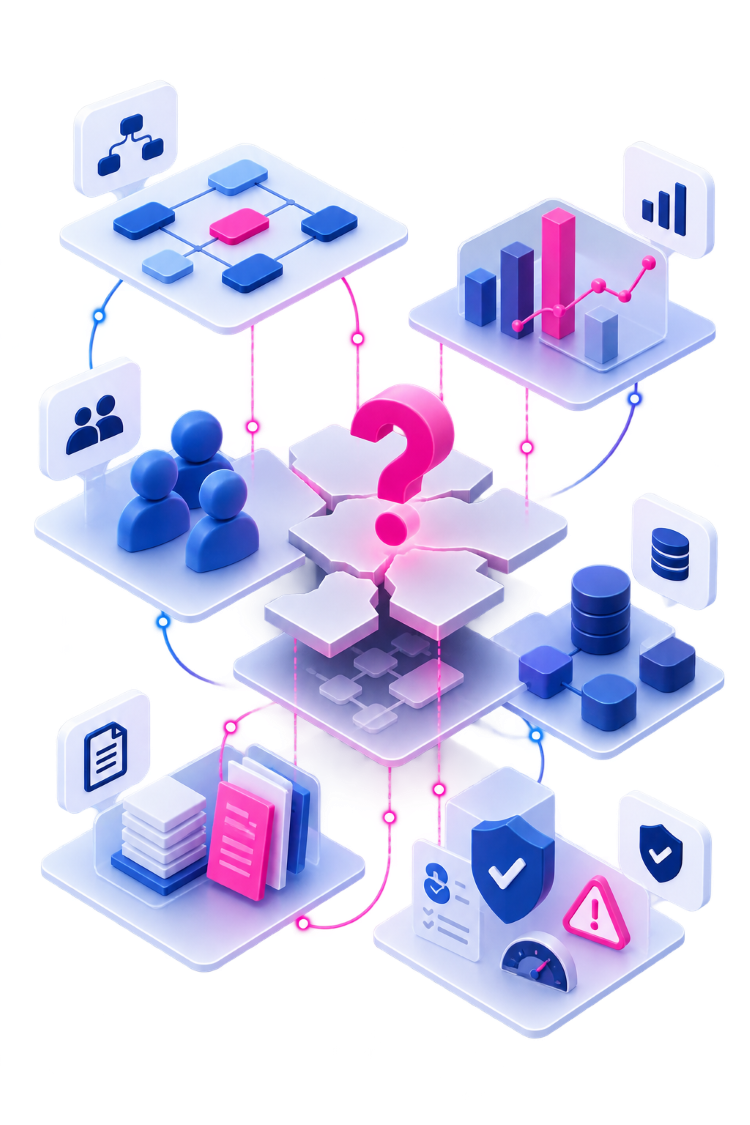
Process models, dashboards, and execution data each provide valuable information. A DTO connects these perspectives with the organizational dependencies needed to interpret performance and assess change. 

 When operational insight is fragmented  With a connected DTO approach 
Process models describe individual workflows.   Processes connect to roles, systems, resources, risks, and controls. 
KPIs identify missed targets without explaining dependencies. Performance measures connect to the operating model behind results.
Process design and execution are analyzed separately. Teams compare intended ways of working with operational reality.
Improvements focus on one activity at a time. Teams assess potential effects across connected activities.
Operational knowledge is distributed across teams and repositories. Governed relationships create shared operational context.
AI receives data without sufficient organizational context. AI can use defined processes, responsibilities, rules, and controls.


Why Is Mavim Different?

  • Unlike static process documentation, Mavim helps organizations create and maintain a living model of connected operational knowledge.

  • Unlike isolated performance reporting, Mavim brings process design, performance, and execution into shared business context.

  • Unlike improvements assessed within one process alone, Mavim helps teams understand dependencies and potential effects across the wider operation.

  • Unlike AI initiatives based on fragmented business knowledge, Mavim supports a governed operational blueprint for increasingly AI-enabled work.

Gebroken Verbindingen met Vraagteken-1

Example in Practice

Investigating a Cross-Functional Bottleneck

Illustrative application of the brief’s approach.

Challenge
An operations team sees recurring delays in an end-to-end process. Its dashboard shows missed targets, but the process model does not explain how upstream activities, system handoffs, and shared resources contribute to the problem.

Approach
The team starts with that process and connects its activities, responsible roles, systems, resources, KPIs, and execution data in a DTO. It compares design with actual execution and assesses dependencies before selecting an improvement.

Expected outcome
The team gains a clearer basis for investigating causes, assigning ownership, and evaluating change without shifting the problem elsewhere.


 What Operations Leaders Can Take Away 

Connected Operational Visibility

Understand how processes, people, systems, and resources combine to shape performance.

Better Improvement Decisions

Evaluate bottlenecks and change opportunities in the context of operational dependencies.

A Focused Starting Point

Begin with a critical process, performance issue, or cross-functional operation.

A Governed Foundation for AI

Build the process knowledge, responsibilities, and controls needed for AI-supported execution.

Frequently asked questions

Do we need to model the entire organization before starting a DTO?

No. A Digital Twin of an Organization can begin with one operational priority. Connect the processes, people, systems, resources, data, performance measures, and controls needed to understand that priority, then expand as requirements evolve.

What are the five DTO maturity stages described in the brief?

The stages are Map, Measure, Monitor, Optimize, and Autonomize. They progress from understanding process design to connecting performance and execution, evaluating improvements, and supporting adaptive operations within a governed execution framework.

How does a DTO help teams assess change before implementation?

A DTO makes relationships between processes, systems, roles, resources, controls, and downstream activities visible. Teams can use those relationships to assess which parts of the operation may be affected before implementing a change.

How can a DTO support supply chain and cross-functional operations?

A DTO connects dependencies across teams, systems, resources, partners, and end-to-end process flows. This helps teams understand how a disruption or change in one area may affect coordination and performance elsewhere.

Can a DTO support ERP or Microsoft Dynamics 365 transformation?

Yes. A DTO can connect an ERP or Microsoft Dynamics 365 process to the operational context in which new ways of working need to succeed. That context includes responsibilities, systems, dependencies, performance measures, and controls.

How does process mining contribute to a DTO?

Process and event data help teams compare intended process design with actual execution. Connecting those signals to the operating model supports investigation of variation, bottlenecks, and the causes behind operational performance.

Does the Autonomize stage mean removing human oversight?

The brief describes Autonomize as enabling continuous adaptation within a governed execution framework. Recommendations, orchestration, and automation remain aligned with defined processes, ownership, controls, and business outcomes.

Mavim in one sentence

 Mavim helps organizations connect processes, people, systems, performance, and governance in a living operational blueprint for continuous improvement, transformation, and AI-enabled execution. 

Trusted by industry leaders:

JM Avanade1 microsoft-logo-png-transparent-background-1_0 HSO logo 2021 with tagline_rgb Zeppelin-CAT-Logo.svg
★★★★★

"Transform Business Processes with AI-Powered Intelligence"
